“What one thing in class surprised you?”

Tap here for class details and to enroll.

IMPORTANT: After this Fall 2019 session of the class, I don’t plan to open it again until fall of 2020. Even if you intend to wait until after the new year to start a blanket, you might consider signing up for this session. You can access it—and the group’s private Facebook page—ANYTIME!

• • • • • • •

In offering the Felted Wool Blanket Master Class again this fall, I want to provide useful information for anyone wondering if this course might be the right fit. Earlier this week you were able to read what things students have found most valuable in the course. Today I thought it’d be fun to hear what most surprised class participants. Here you go!

“What was the one thing in the class that surprised you?”

“I was surprised that it wasn’t as difficult as I thought it would be. You break every step into small, easy to follow segments. I wasn’t as overwhelmed as I thought I would be.” —Anonymous*

“Your wonderful design tips! This was an extra bonus beyond the mechanics of blanket construction.” —Annie

“How much fun it is so see everyone’s creations, and also how helpful it it to communicate with everyone through FB, on different issues we might be having making the blanket.” —Anonymous

*Some responses are “Anon” due to my experiment with one anonymous survey.

“I was totally surprised at how wonderful my blanket turned out, a testament to your organized way of instruction! I made a few mistakes along the way, but I was either able to fix it or it wasn’t noticeable. The wool was forgiving, especially on the binding.” —Linda B.

“I was surprised at how much I looked forward to seeing everyone’s work and questions.” —Sara

“How manageable it was!” —Anonymous

“The wonderfulness of the group. So much fun.” —Linda C.

“How difficult the design phase is! It’s also arguably the most important part.” —Timary

“Gosh, there were so many things. I have been making my own blankets for several years now, and I guess I was most surprised and delighted to learn from you some techniques for improving the quality of my blankets. This last blanket I made was a vast improvement in quality from some of my more recent blankets, and that thrilled me.” —Pat

“All of the practical tips and demonstration. The color selection and design section was a pleasant surprise.” —Anonymous

“How fun it was to be part of a group all doing the same thing, reading the comments, and seeing the pictures.” —Sally

“That there is such a thing as twin needles. I’ve had my mom’s sewing machine for 18 years. She had the twin needle in with the accessories; I had never even noticed it before. I will definitely use the twin needles again.” —Simone

Earlier this week I posted answers to the question, “What was the most valuable part of this class?” Later this week,  I’m excited to be able bring you a special guest interview with Marina, a student from an earlier session of the class. She is about to begin her third blanket!

Would you like to learn more about the course? You can find that info HERE. Do YOU have any questions you’d like to ask me about the course? Please contact me HERE. I’ll be glad to answer!

Enrollment now open!

Enrollment is
NOW OPEN

for

the Fall 2019

—  Felted Wool Blanket Master Class  —


Class begins October 1


—  Consider joining us!  —

Looking for more information about the course?

    • Read all about the course details here.
    • See what past students have said about the course here.
    • Watch a video with 8 reasons you just might want to make a wool blanket here.
    • Read about one method of finding inspiration for a wool blanket here.
    • Have any questions I can answer for you? Write me here!

■ ■ ■

IMPORTANT: After this Fall 2019 session of the class, I don’t plan to open it again until fall of 2020. Even if you intend to wait until after the new year to start a blanket, you might consider signing up for this session. You can access it—and the group’s private Facebook page—ANYTIME!

“What was the most valuable part of class?”

Tap here for class details.

IMPORTANT: After this Fall 2019 session of the class, I don’t plan to open it again until fall of 2020. Even if you intend to wait until after the new year to start a blanket, you might consider signing up for this session. You can access it—and the group’s private Facebook page—ANYTIME!

■ ■ ■ ■ ■

Each time I’ve taught how to make blankets, I’ve solicited feedback so I can be sure I’m addressing all the right things. And each time I’ve taken an online class, I carefully read what previous students say about that course. It’s really helpful in deciding if a course is a good fit.

So here for you are the thoughtful answers of past students to one particular post-class question:

“What was the most valuable part of this class?”

“There were SO many valuable parts—but I especially appreciated the discussion on design/color arrangement, the resources (books), using a color wheel, and making the binding. The advice on how to sew it on was so helpful!” —Linda

“The tips for cutting the sweaters!” —Annie

“The comfortable and non-dogmatic way you teach. You inspire confidence right away, you teach step-by-step so that it is never overwhelming. Your responses to any questions are prompt and most helpful.” —Anonymous*

*Some responses are “Anonymous” because I experimented with using an anonymous survey for one class session.

“The videos were invaluable—watching you actually do what you were explaining made all the difference. For example, I had never put a binding on an item but easily understood with the video.” —Timary

“Your lessons were very well-organized and they were digestible bits of lessons. I often had only 30 or so minutes of time to spare, and your short lessons allowed me to feel like I was able to stay caught up! I loved that you had written notes in addition to the videos.” —Pat

“Learning how to handle the wool. It is vastly different from cotton. Wiggles and moves all over the place. Seeing the techniques you used to cut and sew it were helpful.” —Patti

“I loved that the course was broken down into manageable parts. It was great to get feedback from you and others in the group. By encouraging us to introduce ourselves, it really felt like we were there to support each other. Also, you know a lot and could provide references or additional resources to learn more if we wanted to.” —Sara

“I loved everything about the class: listening to you (you have such a soothing voice), seeing your creations step-by-step, seeing your recap segments, seeing others’ creations. It was a great investment.” —Anonymous

“I loved the section that covered making the binding. I’ve done some blanket making on my own and have never tried this method. I also loved the challenge of doing some math to figure this out.” —Stephanie

“I loved the ‘real time’ aspect of your videos and seeing you demonstrate all the techniques start to finish. I especially appreciated (and benefited from) seeing you struggle to find a layout for your blanket that you liked. It was helpful to see you arrange and then rearrange your blocks and in that demonstration, we were able to then understand that it is a process with no right/wrong answer. I also loved the practical feedback you provided people on their layouts.” —Pat

“The videos were the most valuable part of the class! I like to learn by watching, and they were very easy to follow. Also, the written instructions were helpful to go back to, so I didn’t have to rewatch the videos.” —Sally

“The wonderful instruction on every detail of the process.” —Anonymous

Later this week I’ll post answers to the question, “What was one thing in the class that surprised you?” And I’m excited to bring you a special guest interview with a past class participant who is about to begin her third blanket!

Do YOU have any questions you’d like to ask me about the course? Please contact me HERE. I’ll be glad to answer!

A Helpful Method to Begin a Blanket

Are you pondering whether to make a felted wool blanket? If you’ve been planning one for awhile, you may already have some sweaters collected. If you’ve just begun thinking about it recently, you may have gathered only a couple—or none at all.

Well, it’s nearly fall (for half the planet), which means sweaters are in resale shops around here and it’s a good time to go after them!

There are typically two things I think about when I look for sweaters. First, I consider fiber content and features. If you’d like to learn more about those, you can sign up here for my video, “Find and Choose Good Sweaters” (which will also add you to The Green Sheep email newsletter list).

Second, I need to think about combining colors. That’s what I’m going to talk about today.

Here’s the very, very best question to ask when combining colors:
When you put two sweaters next to each other, DO THEY SING? Do they ask to be playmates? Do you hate to separate them?

If you answer YES, then keep those babies together. They are
going to be beautiful in a blanket!

That is an excellent place to begin. But of course, pulling in even more sweaters and their colors can become a bit complicated.

I’m not going to call you crazy if you buy up all the wonderful sweaters you can find (umm, yes, I’ve done that, more than once). But that approach can leave you overwhelmed with possibilities. Another way would be to have a few ideas in mind as you start browsing.

But where do you get ideas?

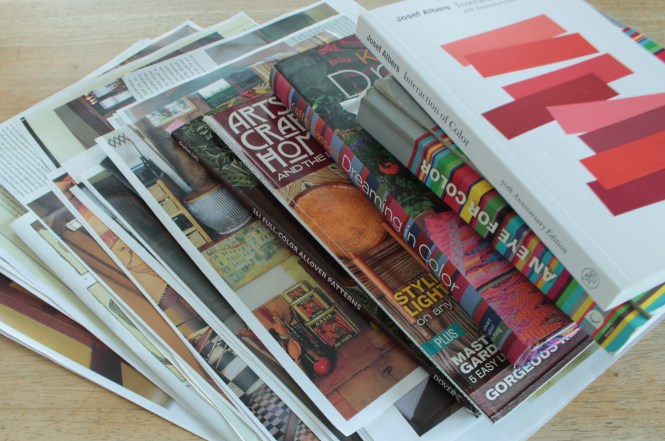
For me, it’s often from photos, lot and lots of photos. When I first began making blankets, I feasted on photos in order to learn what I liked about various color combinations.

Way back at my start in The Green Sheep, I headed to the library for books of beautiful interiors. I made color photocopies of mesmerizing color combinations for my own reference. (Unfortunately, I can no longer find the titles of these wonderful books.) The blues and gray-greens in the right-hand photo with that golden wood harp—Wow! That one is still a favorite, and I’ve not thoroughly capitalized on it (although there are echos of it in “Quiet at Last,” below).

I’ve long loved Arts & Crafts-era objects, design and colors, so I browsed those books as well, and even subscribed to a magazine for a couple of years. William Morris’ Bird upholstery on the ebony chair, below, inspired “The 70s Throw” in the pic just underneath it.

This little book, An Eye for Color, has sparked ideas for many projects. (I’ve actually mentioned it several times, initially here. It has played a part in several blankets, including “A Sunbeam to Warm You” and “Summer Nostalgia.”

Author Olga Gutierrez de la Roza organizes this book by color, populating it with photos of a wide variety of art pieces. She then pulls out several of the colors present in each and prints an accompanying “palette.”

The colors in this painting of the woman are deeper but similar to the colors in a fave photo I already showed you above. I’ll repeat it here (the one on the left). Right?? Over time I began to see patterns in what I’m drawn to.

This photo idea thing can work two directions: Method 1 starts with the PHOTOS and Method 2 starts with the SWEATERS. In Method 1, I use photos to help me dream up a complementary set of colors, and then  I look for sweaters to be part of that plan. In Method 2, I look at what sweaters I have on hand, and then use photos to get an idea of interesting combinations.

In a riff on Method 2, I also refer to photos to help me solve questions of how to mix several color hues and values in one blanket. (This is especially true when a client ships me a box of many sweaters, all destined for one custom-ordered blanket.) For the blanket that became “Happy Winter,” I started with sweaters in complementary color families—blues, purples, pinks, reds—but the mix of brights and pastels felt very choppy together. This pic below from Gutierrez’ book helped me understand how I needed to establish order and pattern to bring together the high-contrast colors smoothly. You can find the final “Happy Winter” below.

Happy Winter

A book of Hans Christian Andersen tales, illustrated by Lisbeth Zwerger, helped me recapture a childlike freedom to play with the many, many pastel-colored sweaters that arrived in a client’s box to be put into a little girls’ bedspread. Those sweaters eventually became “Calliope’s Castle,” below.

Josef Albers’ Interaction of Color helped me understand the power of placing particular colors next to each other. I realized after-the-fact how influential the book had been, even years after working through it, when I stood back after finishing “Blessed are the Merciful,” below.

©Joan Olson “Blessed are the Merciful” (61×75) Felted wool sweaters

There you have it. There are infinite resources out there, right? I encourage you to find what color combinations you like. Start anywhere! Capture and save online photos, search your bookshelves for beauty, sit in front of your favorite “picture book” section of the library and choose some print materials—magazines? art books? interior design books?  And always, always hold your sweaters next to each other and see which ones are begging to be partners. Have fun!

Where was I?

It’s Baaack!
The Felted Wool Blanket Master Class will begin October 1, 2019!
(Enrollment starts September 24)

Interested in learning more? Read all about it on the course info page here. In addition, you may sign up for updates through my email newsletter, and I’ll send you my super practical video
on how to choose sweaters for any felted wool project.

It contains footage from the Master Class so you can have a peek at my teaching style!

(Note: If you’d like to see the video but you’re already on my email list, still click the button and complete the form for video access; your address won’t be duplicated.)

*******************************************************

This past weekend my husband and I were sitting in this ↑ coffee shop in central Wisconsin, coffees in hand, unfamiliar (to me) top-10 music in the background. It’s nearly the end of the summer season for this little lake town, and families of multiple generations were stopping in for ice cream. The teens and preteens mouthed the words to the piped-in songs, politely stopping to answer their grandparents’ questions. Hubby and I split an Amish doughnut as the shop proprietor told us this was nearly the last weekend for them. Erik chose a chocolate one. It was airy and delicious.

I pulled out my tablet of paper, as I had set aside this time to write. I’ve been pretty quiet here at The Green Sheep blog, and I thought I ought to explain.

Something internal happened to me this past year. I found I put it differently as the months went on. First I said, “I feel flat, like something died in me.” Or, “The bottom just fell out of me. I miss myself.” My intense joy in blanket-making was hollowed out too, and that shook me. Later I said, “I’m not sure I can face the things that need doing. Mostly I just want to go sleep.”

When I found tears popping into my eyes in just about any conversation, I made a doctor appointment.

As I began to recognize this as depression rather than just “feeling low,” I got better at making changes. I cut back on travel and on involvements. I’m getting better sleep. I sit on our deck and absorb the straight-up outdoors almost daily. I’ve revived the practice of reading fiction, something I used to do regularly.  I practice “Be still and know that I am God.” I pray, I trust. I plan little mental health breaks, I spend less time on social media. And, yes, I’ve added a tiny pill to my morning handful of supplements.

In retrospect it’s easier to see what was going on. (Always, right?!) In the language my speech therapists colleagues, I had spent all my Brain Bucks…and I was not socking away any new ones in savings. I was depleted.

But, guys, I’m delighted to tell you that the pendulum is swinging back. I’m making my first blankets in months. I’m taking my time, enjoying the pace and the process. I’m currently working on a custom order of three blankets and I’ll be sharing photos as soon as I can.

A handful of you have written over the past months, asking whether the Felted Wool Blanket Master Class will be offered soon. Your understanding and encouragement have meant a ton, even as I was honest with you about where I was. But thank you! Your hope became my impetus!

I’m still taking thing slowly, but I certainly feel the old Joanie I know and recognize has returned.

Skirt Skills

Nearly 3 months ago I began a 5-week online class to make a skirt of my own design, based on a “skirt block” which I created according to my own unique measurements (and they are unique! More on that shortly).

The class, called Skirt Skills,* is offered by Brooks Ann Camper, a custom maker of wedding wear. Essentially and amazingly, Brooks Ann is able to bring a bride’s dress from dream into reality.

She pretty much helped us newbies do the same with our simple skirts. I learned so much!

I’ve sewn many articles of clothing for myself and family members through the years, but fit has always been a bugger for me. I’ve tended toward patterns where shape is forgiving in order to compensate for my lack of…what? understanding? patience? knowledge? All of the above, really.

The process in Skirt Skills has been so interesting that I wanted to give you a glimpse into how the course worked and what I’ve gained from it. I’ll take you through the main steps chronologically.

1. The first thing we did in the course was reflect on particular skirt ideas to add to our wardrobes. I was looking for something simple for summer, straight or A-line, to wear mostly with simple knit shirts. In the back of my mind, I also was tempted to try cutting a skirt on the bias, as a particular bias skirt in Lotta Jansdotter’s book Everyday Style had caught my eye:

We then learned how to use photos to draw a custom outline of our selves. On mine, I drew some possible skirt designs. Here were my early, simple sketches:

That’s actually when my “unique measurement” problem first showed up. In the third drawing, I look like I’m leaning to my right even when I distribute my weight evenly over my feet. It turns out my left hip is higher (and fuller) than my right hip. Yikes. This affected every single step of this skirt-making project.

2. The next step involved taking lots of measurements in tights. (More than once, too, because I tried to do it alone but it’s tricky to hold the measuring tools straight and read them correctly. Things got easier once I asked my hubby for help.) I’ll share one small, humbling photo of me with elastics tied on to let you see the hip discrepancy I had to deal with. Yikes again. My crazy crooked hips throw off everything above them.

3. I took the measurements and then did a smidge of math to determine my block dimensions and to decide on dart width, length, and placement. I drew each one of those onto heavy paper for the first draft of my skirt block.

4. Next, I traced around the block to transfer all those measurements to a piece of fabric for my muslin or mock-up. (I used an old sheet after I made sure it squared up nicely). You’re seeing the mock-up here after tons of adjustments, multiple bleeding finger pricks where I pinned it closed at the side seam, and many moments of setting it aside and going to the Skirt Skills Facebook page to ask Brooks Ann yet another question. I kept adjusting until I got it to sit correctly on me.

5. Once all parts fit correctly, I transferred the changes back to my brown paper block. I then went the extra step of sewing up a second mock-up to make sure it would actually fit correctly and could be used for future patterns. Yes! It worked!

With that, I made a more permanent skirt block out of poster board, below. To accommodate my unruly hips, I chose to have all FOUR skirt pieces mapped out for my block (so there’s a separate Left Back and Left Front that’s not pictured here). If I were symmetrical, I could get away with just two pieces.

6. Shopping! I made a trip to Holland, Michigan, to visit my daughter—during Tulip Time, no less. I arrived a couple hours before she was off work in order to GO TO FIELD’S FABRICS!! I lived in Michigan for 10 years and was smitten with that store. I miss it here in Illinois.

I came home with more fabric cuts than I had intended to buy (of course), but this class has inspired me to boldly try sewing more clothing. I particularly liked this interesting and heavy blue and white cotton, very Scandinavian (I’m married to a Norwegian who loves his blues) and with an abstract hint of tulips. Well, I see tulips; I’m not sure about anyone else. I wondered if the fabric was too heavy, but what the heck! I talk all the time about being willing to experiment while making blankets, so it came naturally to me to experiment here as well.

7.  I made a pattern for an A-line skirt off of my skirt block, following Brooks Ann’s guidelines, tailoring it to my own likes as far as width, length, darts or no darts, etc. Here’s that pattern, created from a skirt block copy. I traced around all pattern pieces directly onto the fabric, adding wide seam allowances for any adjustments needed during the making of the skirt.

8. After stitching in the darts and basting up the long seams, I was at another point of decision. Pockets or no? Zipper hidden or exposed? and at which seam? I had several zippers on hand to choose from—ones I’ve cut out of wool sweaters over time. No surprise!

I nixed the pockets. The fabric was too thick and the pattern too busy to make them a good idea. And I YouTubed my way through inserting an exposed zipper for the first time. Pretty simple! Mine’s not perfect, but I don’t think its shortcomings will be too visible. I’ll just have to keep moving :).

Eleven weeks later, my custom-designed, custom-fit (by ME) skirt is finished. So cool!

I learned to use a few new sewing tools along the way: a hip curve, a needlepoint tracing wheel (I already owned one, but here is a similar one), a thimble (I tried this leather one), and new Gingher dressmaker shears.

Guys, I have never ventured into the self-drafting world before. Blocks and slopers, muslins and mock-ups—I had heard this terminology but basically ignored it because it sounded like way too much to delve into.

But it’s fascinating! My patience for re-dos does not yet quite match my desire to solve any given fitting problem before me, but it is improving. I was proud of myself for persevering through my asymmetry trials. And now that it’s behind me, I can barely remember the frustrating moments.

A HUGE shout-out to Brooks Ann Camper, her Skirt Skills course, and her patience and willingness to work with me through every single confusing thing I ran into. I’m thrilled with what I learned and understand much more how satisfying and worthwhile it is to take the time to get things right for one’s own body.

I find I can’t stop thinking about other skirt designs and what I’d have to do to my skirt block to actually form what I’m imagining. Pockets should be in my future shortly!

*This is an unsolicited review. The opinions expressed are my own.