“Do you teach how to make blankets?”

[I’m afraid it’s too late to join the class, but you are welcome to pack your own shoe box for a child in difficult circumstances. Follow this link and let a young person know someone cares. It means more than you can know.]

How could I have known how much fun I was about to have?

Two weeks ago, after brewing up the idea just days earlier, I launched a little online class. Well, I thought it would be little.

A still shot from my “Welcome” video, made in the guest bedroom. I accidentally got the bed in the frame.

I regularly receive questions from blog readers about making blankets: “How do you make your binding?” “Do you back your blankets?” “What kind of sweaters do you buy?” I do my best to answer these sewists, one at a time, generally through email. They are always enthusiastic and eager to learn, and are filled with questions. I love this interaction.

But each time I’ve been asked, “Do you teach a class somewhere?” I’ve simply said  “No.” That limp answer started to bother me. What was stopping me? I knew: fear of the unknown.

The first frame of my third video. I’m still figuring out lighting.

Then I received a notice about Operation Christmas Child coming up and was reminded I wanted to make a child’s blanket again for a shoe box. It clicked. This could be the kick in the pants I needed! How fun would it be to create something beautiful for kids alongside a bunch of stitch-loving women?

I thought of other ventures in life I had waffled on because of fear of the unknown—going to grad school, starting a blog…having children :). Without a doubt, great outcomes, all. I certainly appreciate having my ducks in a row, but that can’t always be.

Two weekends ago, with me needing to master several things quickly, the unruly ducks waddled everywhere:

How do I use the format of a private Facebook group to teach a class?
How do I sequence MailChimp’s forms and confirmations to move people
into a virtual classroom?
How do I make videos, edit and post them?

The dining room set up with lights and camera for a session on laying out a blanket. I had to be careful not to trip on cords while taping.

Fortunately, I already had an outline of course content because Tara Swiger’s practical book Map Your Business recently propelled me to draw up action steps toward some goals (even though I was avoiding executing them!).

So I borrowed photography lights, watched YouTube videos about how to make a video, made two videos using my outline notes, and sent out an invitation to my email subscribers to join me in making a child’s blanket for an Operation Christmas Child shoe box.

I expected three people to join me, and I am not kidding. I was a bit off. Two dozen people signed up!

Scripts for the videos, often taped to the lower half of the camera.

Now there we are, over on Facebook, having a ball. A group of fascinating women teaching, learning, encouraging and spurring one another on. And doing our level best to hit the National Collection Week deadline of November 13-20 for our blanket-filled, lovingly packed shoe boxes.

I’m learning so much from these women! It’s spurring me on to make a plan for more teaching.

[I’m afraid it’s too late to join the class, but you are welcome to pack your own shoe box for a child in difficult circumstances. Follow this link and let a young person know someone cares. It means more than you can know.]

A still shot of some fancy graphics, before I learned more video-editing. The advice certainly fits my learning curve too!

Name That Blanket…Results!

Thanks, everyone, for stirring up your creative juices to help name this blanket! You guys are great. This is the blanket that got packed up in an Operation Christmas Child box a couple of weeks ago. But as I was writing the blog post about it, I suddenly realized it had been sent out without a name. But names matter! Many of you came to the rescue, adding ideas on Facebook, Instagram, and this blog. A couple of you emailed me.

img_8334a

These are the wonderful ideas that came in. Making the final choice was difficult!

Blanket of Love
A Bright Beginning
Christmas Child
Promise
Pastel Peace
Colors of Love
Quiet Rainbow
Heaven’s Hues
God’s Perfect Promise
The Christmas Rainbow
A Rainbow of Love
Vibrant Love
A Box of Sherbet
Ribbon Candy
A Rainbow Promise Pocket

img_8345a

After much deliberation, the WINNER IS…

    ♥ THE CHRISTMAS RAINBOW ♥

I realized I wanted it to be a name that worked from a child’s perspective, so I tried to think like a little one. “The Christmas Rainbow” rose to the top because 1) I could imagine a child thinking it; 2) both “Christmas” and “rainbow” hold all the significance of the promise within each one of those; & 3) the blanket is not REALLY rainbow colors or rainbow sequence, but it is unusual, like a rainbow at Christmastime would be. Credit for “The Christmas Rainbow” name goes to Melissa Dugan.

And now this blanket can find its proper place in the world, since it has been named :)

img_8338a

[Click here for the full story of “The Christmas Rainbow.”]

A blanket for a stranger

(“Strangers are friends you have yet to meet.”)

img_8362a

This is the final collection weekend for Operation Christmas Child shoe boxes. OCC is a faith-based global effort that sends off gifts packed in shoe boxes to children whose lives have been touched by disasters, war or poverty.  I’ve known about this activity for years; I even know two wonderful young adults who were significantly affected by the shoe boxes they received as children in a Russian orphanage many years ago.

But I sheepishly admit I never packed a box myself until two weeks ago.

img_8335aimg_8334aimg_8350a

A few weeks ago, my church made available empty shoe boxes from OCC, and my small group (a baker’s-dozen of great women) decided to have a packing party of our own. We each volunteered to shop for 13 somethings–toothbrushes, toothpaste, pencils, pads of paper, candy, toys, wash cloths, bars of soap, socks, cards and more–and bring them together to pack boxes. (I picked up some of Ikea’s colorful children’s tableware.) We were each to also add one “Wow!” gift to our own box. My “Wow” gift was a soft, sweet-eyed, stuffed-animal puppy.

img_8338aimg_8339aimg_8345a

A few days before our packing night, both of our grown daughters (and 10-month-old granddaughter–gah!) happened to be visiting for the weekend. Saturday evening we popped in the DVD of a film recommended to me by a co-worker: The Drop Box. The seed for the film was planted when a young Los Angeles filmmaker (with Sundance aspirations) was eating breakfast one morning over the LA Times. On the front page, he read a story about a pastor in Korea who rescued unwanted babies by building a small warming box in the wall of his church, a “drop box” for newborns. The film is interesting, surprising, and to me, very moving. I came away with a renewed sense of the deep value of every single life.

As often happens in my brain, the experience of the film mingled with some other information up there in my head. In this case, I was thinking about a woman named Gift I’ve gotten to know a little this past year. Gift is from Zambia, and every year she raises money to send to her village for blankets for the women and children, who often do not have one of their own.

Sunday morning I woke up with one thought on my mind: I wanted to pack a wool blanket in my little shoe box, to let its young recipient know that she is one-of-a-kind in this wide, wide world, and someone somewhere was thinking about her.

img_8337a

So that Sunday morning I pulled out my stacks of already-cut strips of wool sweaters, to see what child-friendly combination I could assemble. But it wasn’t working. I needed to start from scratch. With those bright Ikea dishes nearby, I chose a rainbow of saturated colors and got to work. I had just been working on a custom-ordered child’s blanket with diagonal stripes and decided to repeat the pattern. I love its youthfulness and sense of movement.

As I was limited to the interior of a shoe box, I knew this blanket couldn’t be thick, so I chose cashmere, merino wool, and lambswool. The result? It’s exceedingly lightweight and yet cozy and warm.

I hope it can feel like a cuddle to a little girl.

img_8341aimg_8349aimg_8352a

I made our deadline and packed up my box. (In the photo, it looks like the blanket is taking up the whole box, but all the practical items are rolled up in the blanket.) Unfortunately, there was not enough room for that precious puppy. (Not for lack of trying, though! I even bought a bigger plastic box, but realized this would not feel fair to a group of kids on the receiving end.)

Of course, I likely will never meet the “5- to 9-year-old girl” this box is destined for. But I did learn from the woman at the collection counter that among the countries this batch of boxes is headed toward is Zambia :). Godspeed, little boxes!

img_8340aimg_8363a

“A Christmas Rainbow” (Size: 40″ x 50″)
Named by readers in this post here.
The blanket has already gone to a good home.

A self-education

[I’m busy making blankets for an in-house environmental fair by a Chicago-area firm in May. I feel honored to be invited! I’ll post those blankets in a couple more weeks. Meanwhile, let me share some great books I’ve been *reading.]

022a

You folks already know I fell into making these blankets et al. by surprise. My daughter saw a magazine article and introduced me to the concept of reusing felted wool sweaters. So I simply got started, using the trial-and-error method of designing. It’s not a bad method, and I fall back on it often. But the more I designed, the more I found myself looking for guidance.

I began searching for books on design. The trails I followed kept leading me to graphic design or website design, not exactly what I was imagining. But then I happily ran into “Universal Principles of Design,” by Lidwell, Holden, and Butler, and Osburn’s “Secrets of Good Design for Artists, Artisans & Crafters” (a replication of a 1948 book). With these I began to better understand proportion, balance of all kinds, curves, weight, drawing the eye. I have several of their pages bookmarked and refer to them regularly.

029a

But color was still missing from my education. I would page through art books and magazines and study the colors. What did I like? What did I dislike? What made things work? There are lots of books on color theory, and I decided to start with Quiller’s “Color Choices.” Quiller has designed his own color wheel, conceiving of color in the way a painter does (which Quiller is). My bit of watercolor experience gives me a framework for understanding this. Quiller juxtaposes “sketch” paintings of the same scene done in different color combinations, so the reader can feel the effect of color. It’s a wonderful book…and has a side-effect of making me want to keep paints handy for experimentation.

033a

I found another interesting book while messing around on Amazon looking at color wheels. De La Roza in “An Eye for Color” provides incredible photos of all sorts of things and then breaks each entry down into the actual colors used. It’s fascinating to simply sit and study each page. And I found a color wheel that’s made for working with textiles — the “Rainbow Color Selector” by EK Success. All these tools are helping me consider color in new ways.

040a

That little color wheel led me to books by and for quilters, which in turn led me to check out quilters’ websites. Gah! They are amazing artists! See here and here and here, for instance. I feel right at home in these books. Although I am not a quilter, I am inspired by the ideas and colors and arrangements just the same. These wonderful books are Wolfrom’s “Adventures in Design” and Barnes’ “The Quilter’s Color Club.”

So there you are: a little peek into how I’ve been figuring out things as I go :). I’d love to hear from any of you out there who have explored wool-felting, designing with fabric, crafting of one sort or another, or anything else by pursuing a little self-education.

* I use “reading” somewhat lightly here due to the preponderance of pictures in all these books ;)

Why wool?

[I’m working on several projects I can’t post yet, so instead I’ll entertain you with some AMAZING things about wool.]

What’s so wonderful about wool? Why bother with it? Isn’t it itchy, hard to clean, and hot? Umm….no! (OK, some wools scratch, but we can avoid those.)

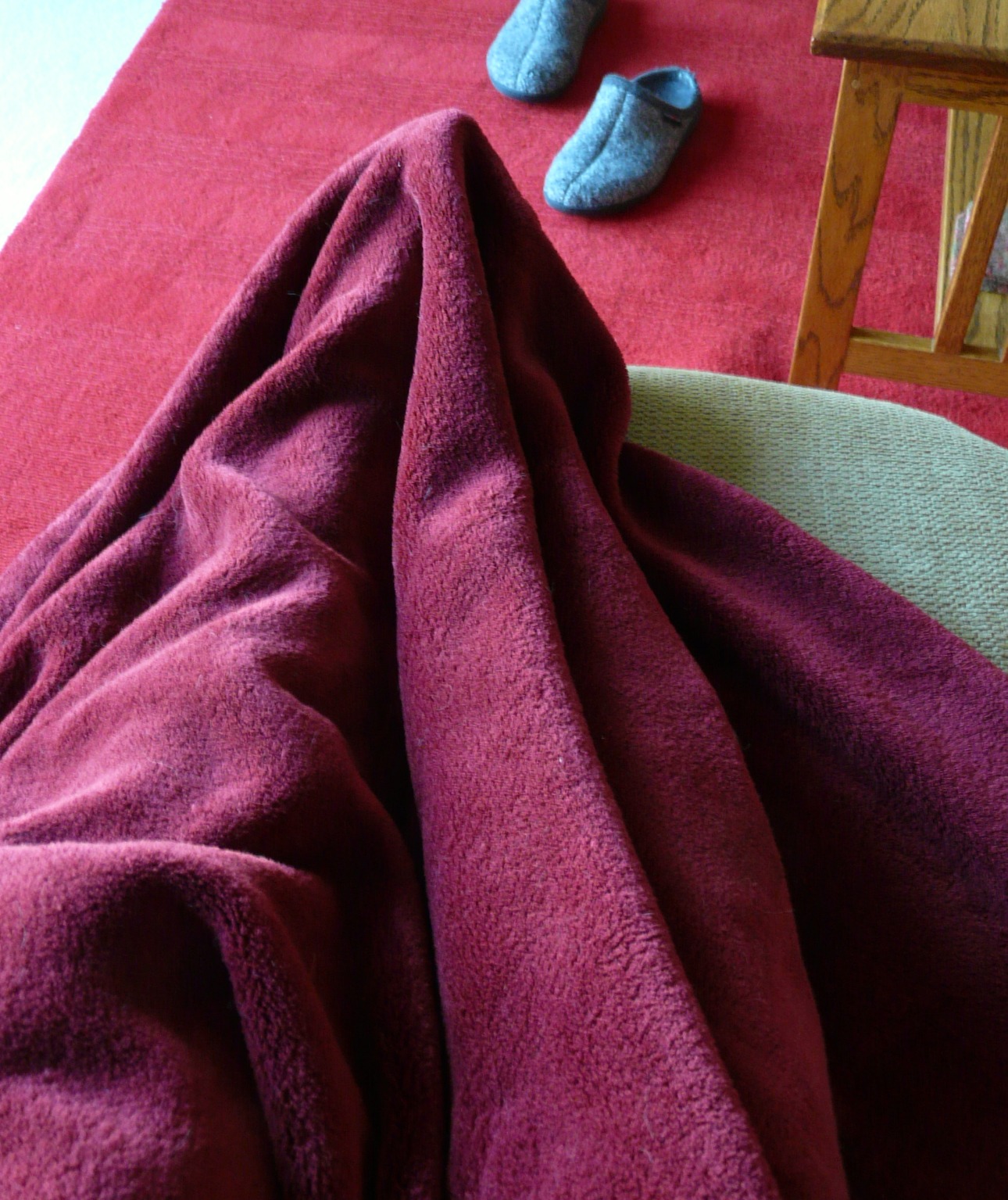
I thought about writing this post one morning when I was up early, wrapped in my robe, reading a good book with a steaming cup of coffee by my elbow, and a synthetic blanket on my lap. I was still cold. Here are my legs, covered with the synthetic fleece blanket —

006a

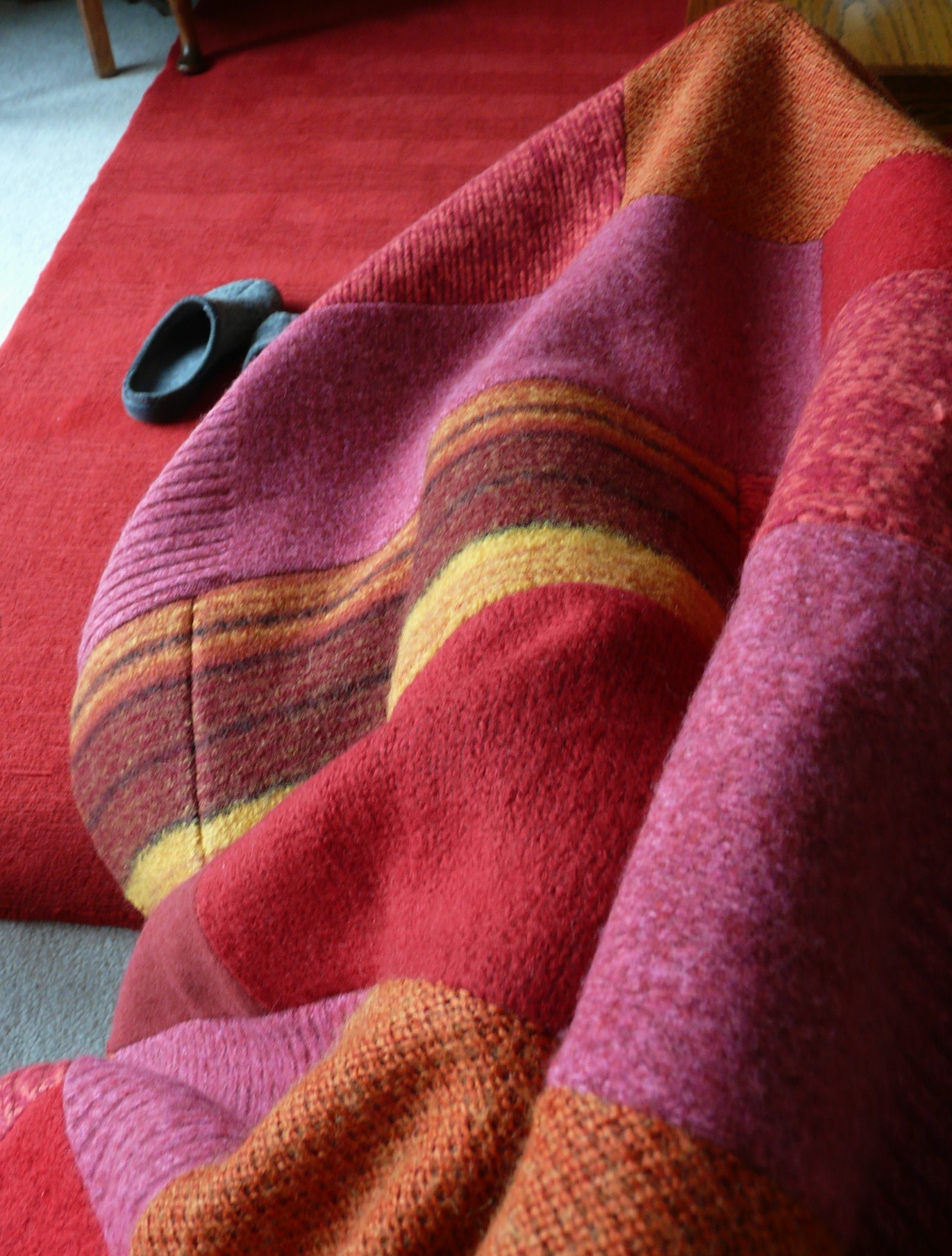
How dumb, I thought. What am I doing when I’VE GOT WOOL? So I got out one of my first blankets. This is Some Like it Hot.” It’s got great colors in it, but I was still learning the best sweaters to use, so it contains one (the orange) that I would no longer choose. Still. WHAT A DIFFERENCE. I immediately felt cozy and could read without distraction.

017a

`

For your trivia library, some amazing properties of wool:*

• Wool fibers insulate without overheating. They are historically used in both the heat of the desert and the coldest arctic climes.

• Many kinds of wool, especially Merino (because its shaft is so slender), are very smooth and extraordinary comfortable on skin.

•  Wool wicks moisture away from the body.

011a

•  Wool fibers actually absorb water and move it temporarily into the core of the shaft, keeping the wearer warm and dry. It won’t feel wet to the touch until it has absorbed 60% of its weight in water.

•  Wool has antimicrobial properties, so it doesn’t harbor odors and stays smelling fresh — in fact, backpackers and bikers are returning to the use of wool, as synthetics cannot yet mimic this.

•  Wool is disliked by dust mites, which are behind many allergies and asthma troubles.

•  Wool in blankets by The Green Sheep has already been washed and dried, so you can carefully do the same with really great results! (See here for directions.)

008a

• Wool holds dyes better than many other natural fibers. (This is one of my favorite properties.)

• Wool is long-lasting. Wool fibers can bend 20,000 times without breaking. Compare that to cotton at 3,000x and silk at 2,000x.

•  Buying wool supports raising sheep for their fleece rather than for food. Every year a new fleece grows on the sheep’s body and is removed without harm to the animal.

•  Buying wool supports local farmers throughout the world. Also, processing wool requires fewer resources than those needed to process most other natural or man-made fibers.

*With gratitude to the following websites for their informative content: Wool Revolution!, Zeilinger Wool Co., and Dennis Baxter’s article on Merino wool on ezinearticles.com.